Review: ‘Antigone: In the Language of Kings’ at Getty Villa


The Getty Villa’s annual classic-play production in its outdoor amphitheater is usually an illuminating and inspiring experience, and this year’s show is no exception — in fact, it’s exceptional.
The Latino Theater Company has transformed ancient-Greek playwright Sophocles’ pointed “Antigone” into a visually immersive, transportive and timely take on the story of a princess who boldly defies her ruler uncle to properly mourn her dead brother.

Only in this retelling, the princess is Antíkona in pre-conquest Mexica and her uncle Tlahtoani Klion, the king of Tenochtitla, a city founded in 1325 by the indigenous Nahuatl-speaking people and the historic center of Mexico City.
Evelina Fernández has successfully adapted the play not only through name and context changes but in gracefully emphasizing the core message that makes “Antigone” relevant at any time, and perhaps especially today, when leaders may “hold their foreheads too high” and away from the people they serve.

Director José Luis Valenzuela uses the large amphitheater stage well in both breadth and depth, with immersive and evocative lighting by “Lee” Xinyuan Li and geometric-design projections by Yee Eun Nam creating an otherworldly feeling.
Strikingly patterned, colored and feathered costuming by Catarina Copelli add to that sense, along with music by Xochi Cuicatl featuring Meso-American instruments directed by Christopher García, with sound design by John Zalewski.

These elements on François-Pierre Couture’s minimal scenic-design set the stage for Latino Theater Company actors to perform in a combination of English and Spanish (though the play is set pre-conquest), along with some Nahuatl words, all translated in supertitles across the top of the stage.
Their deliveries are infused with meaning, purpose and passion across the board — with some humor thrown in by Richard Azurdia and Randy Vásquez, the play’s Rosencrantz-and-Guildenstern-type messengers — reinforcing a powerful story that pits the personal against the political.
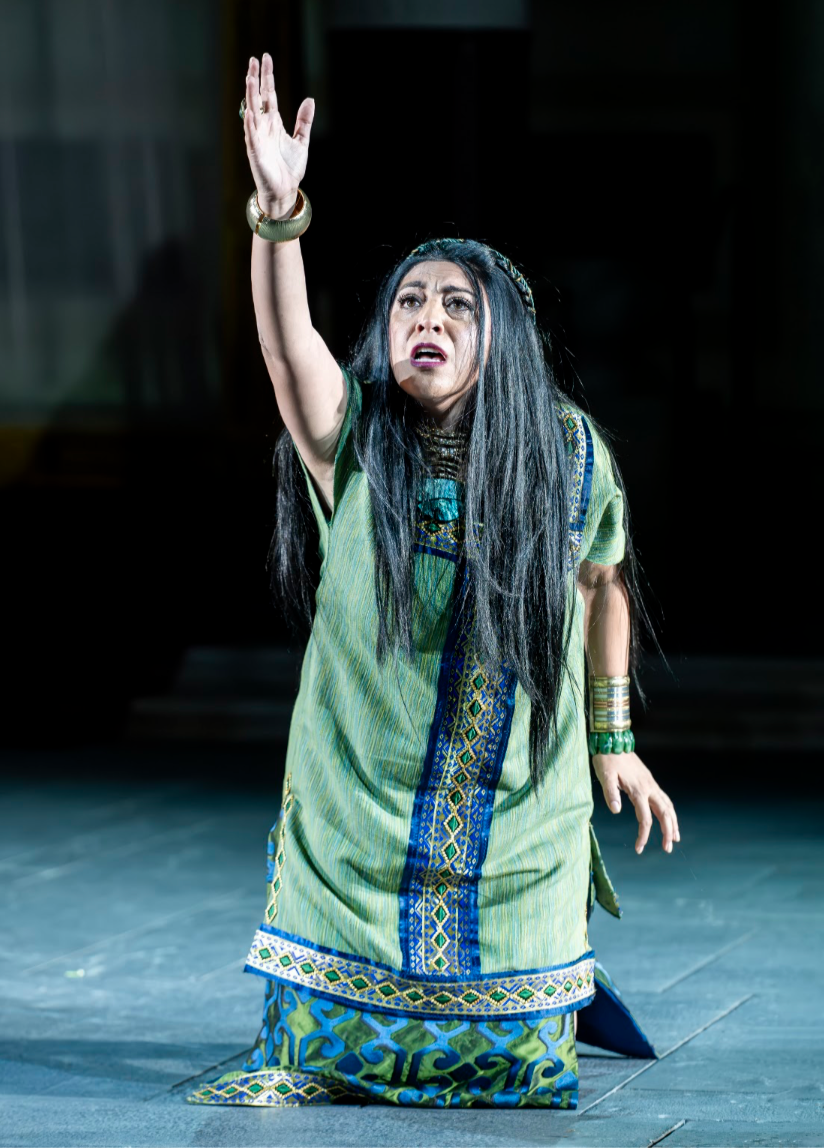
Esperanza América makes a believably committed Antíkona, whose two brothers were killed in a war — staged through Aztec dance choreographed by Urbanie Lucero — but only one of whom is buried with proper funeral rites. Klion (Cástulo Guerra) declares the other a traitor for trying to depose him and says his body should be left for the vultures.
But Antíkona is moved by a higher law than the Klion’s, one that morally compels her to send his soul to the sun with the proper prayers, sage-like incense and cremation. A tall, skull-faced Miquiztli (Tiffany Bonita Litz) in a long black robe silently attends to the ceremony, evoking death’s somber solemnity.

Mask-wearing members of the chorus, or Koro, represent the people of the city, who see what’s going on and at first hide Antíkona from Klion’s wrath. But when she persists and makes her case, the people start questioning whether she is more correct than the king in following divine principles.
Klion has a chance to defend his position, as the play presents a balanced argument, but of course as ruler — and as a male in this society, a gender bias Fernández makes clear — he has the upper hand in banishing Antíkona to certain death, despite the protests of her betrothed, his son Hemon (strongly portrayed by José Eduardo Moreno).

As the play snowballs this way — involving blind seer Tetzahuitl (Sal López) and Klion’s queen Cihuatlahtoani Euridice (Zilah Mendoza) — it gets more emotionally resonant, breaking through its stylized sense of retelling a myth and bringing home its point about humility in an impactful and satisfying way.
While the play’s message is especially welcome now, experiencing it through the Latino Theater Company’s mesmerizing lens makes it all the more meaningful here in California, where a ruler’s law is literally hunting people who want to do work that others won’t, on land that once was theirs.

That the Getty Villa makes possible this unique staging of a classic play is not only culturally commendable but existentially illuminating — offering an imagined glimpse of a world lost to the darkness of pre-history, right here in our own backyard.
“Antigone: In the Language of Kings” continues through Oct. 3 at the Getty Villa, 17985 Pacific Coast Hwy., Pacific Palisades, with shows Thursdays, Fridays and Saturdays at 8 p.m. Tickets are $30 to $60. For tickets and information, visit Getty.edu. Run time is 75 minutes with no intermission.


Comments