Review: ‘Wives’ at East West Players


First performed off-Broadway in 2019, “Wives” by Jaclyn Backhaus is a pastiche of stories focused on wives, mistresses, mothers and witches (in other words, most women), making a comedic case for an alternative to patriarchy.
In East West Players’ coproduction of the play with Hypokrit Live Arts — continuing through Nov. 1 and engagingly directed by Arpita Mukherjee — four talented actors travel across time and space in different characters, blurring boundaries between now and then to bring history into the present and vice versa.
It’s a creative approach to storytelling on stage, especially having historical figures speak with today’s attitudes and profanity-laced parlance. In that way, “Wives” is akin to the 2017 musical “Six,” in which the wives of Henry VIII tell their stories through high-wattage pop songs.

While “Wives” also includes choreographed songs, it’s more dreamlike and whimsical than “Six,” weaving themes of womanhood and witchcraft through disparate, non-linear histories to culminate in a modern-day young woman’s reclamation of her own selfhood.
The first story, for instance, opens with the chef (E.M. Davis) of France’s King Henri II (Parvesh Cheena) demonstrating how to cook a chicken à la Julia Childs, melding an imagined past character and present cultural icon to great comic effect, thanks to Davis’ confident delivery with a French accent and feathered culinary props by Rye Mandel.

That first segment pits Henri’s wife Queen Catherine (Rachna Khatau) against his mistress Diane (Arasha) in terms of which he loves more and especially to whom he leaves his castle when he dies. It introduces the play’s themes of what it means to be wife, mistress or just female in a patriarchal world — but through comedic lines well delivered by the cast.
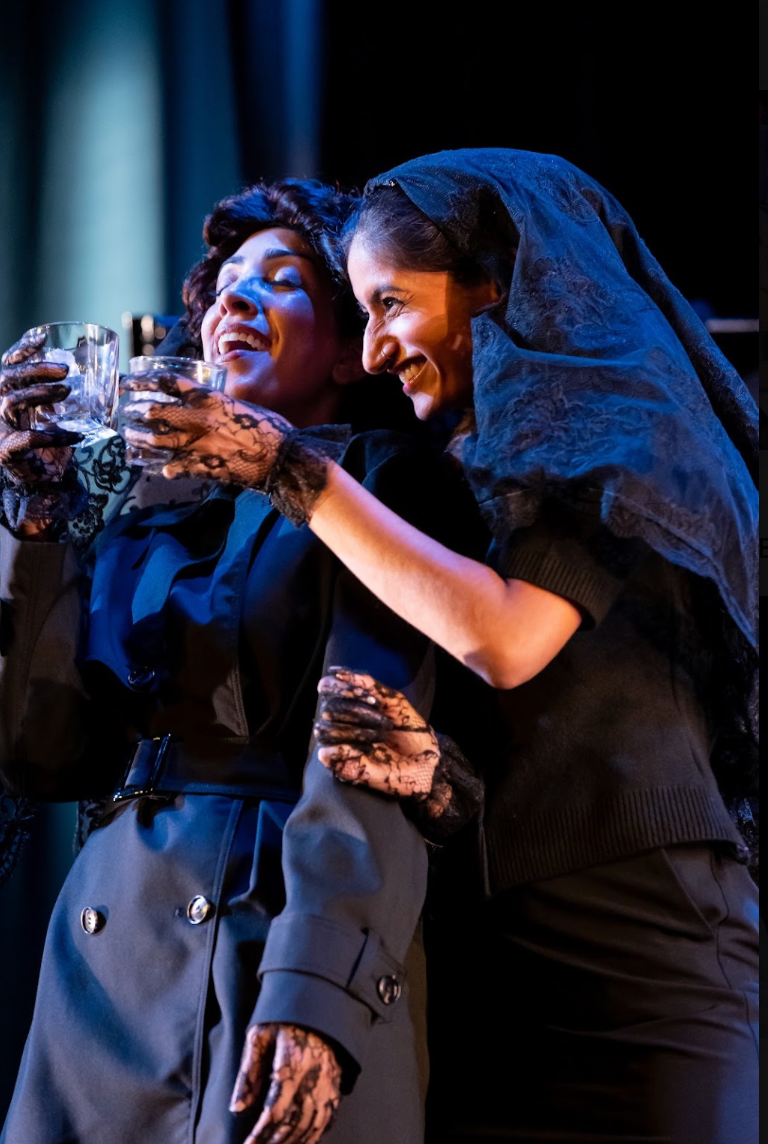
We then jump to 1960s Idaho (reading the playbill ahead of time may help stay oriented), where the surviving wife and two ex-wives of author Ernest Hemingway gather after his funeral, mostly to bitch about him while drinking and imitating his famously “true” and “good” writing. The scene culminates in the women lighting a fire under a marlin that had been caught and mounted by Hemingway, encircling it like the witches in “Macbeth.”

And then to 1920s British India where a maharani (queen) nursing her baby has brought in a well-known “witch” to help cure her husband’s illness with tinctures and seemingly also be his mistress. An uptight British officer keeping tabs on them for the Crown frowns upon the witch’s influence over the maharaja, leading him to burn the women’s quarters, or zenana (a word not defined in the playbill glossary, though it includes “larder” and “joust”).
A possibly autobiographical final sketch has a female “Oxbridge” college student join a witch club, dropping into a cauldron things connected with her heroes, including Virginia Woolf but also Queen Catherine, Hemingway’s widow and the Indian witch. She then gets a visitation by the maternal Indian grandparents she never knew and learns their feelings about migrating to America, ultimately leading her to define a new sense of self.

Celebrating the imagined voices of these women as Backhaus does in attempting to redefine “wife” not as a patriarchally owned being but an inclusive and mutually supportive state of being is certainly commendable. The non-sequential chronology and discrete episodes also enact the kind of writing the college student says she prefers as an alternative to patriarchally prescribed linear forms. And the comedy is spot on.
However, the play’s messages about patriarchy and women are often heavy handed, not registering emotionally, even as inflected through the different places and times. Mistress Diane wants to be friends with Queen Catherine, but it’s more announced than felt as transcending their proscribed positions. The maharaja, maharani and witch say they are all “wives” together, which is funny and intriguing, but we don’t know what that feels like except as a feminized stance against colonialism.
One of Hemingway’s ex-wives says she hides herself, not because of men but because that’s how she was born, though perhaps that leaves out the role of the mother in transmitting patriarchal values since no baby literally hunches their shoulders to make themselves smaller as she describes.

And the college student’s list-like monologue at the end, choreographed with her building an unstructured structure of cloth on boxes, is well detailed and impassioned, but never allows us to feel her self-empowerment. We only see it enacted. For all the mention of witchcraft — suggesting transmutation and alchemy — the audience’s emotions are rarely acted upon enough to allow us to internalize what the characters portray.
The main exception is the end of the Hemingway segment when the three wives morph into witches around the burning marlin. It’s both hysterical and evocative in a way that transcends time and place. Through their dance, the women become a unified power that needs no words, the scene’s comedy continuing as one of the women peers at us in silence from below the fish.
More such stage “magic” would make this creative and well-written play more believable and moving, helping us transform our concept of wife, mother, woman to become more than an idea of something different.
But “Wives” is nonetheless entertaining, funny and thought-provoking, thanks to its invested cast and Mukherjee’s fluid, well-paced direction. It’s refreshing to see such creativity on the stage, lovingly and vividly produced, seeking to break boundaries in more ways than one.
East West Players’ “Wives” continues through Nov. 1 at the David Henry Hwang Theater, 120 Judge John Aiso St., Los Angeles, with shows Mondays and Fridays at 7:30 p.m., Saturdays at 2 p.m. and 8 p.m. and Sundays at 5 p.m. Tickets are $15 to $25 or pay-what-you-will and can be purchased at EastWestPlayers.org. Run time is 90 minutes with no intermission.


Comments