Review: A timely history lesson in ‘Ascent’ at Skylight Theatre

Recently, many Americans (and people around the world) were captivated by the Artemis II mission, which was the first crewed flight beyond low Earth orbit since Apollo 17 in 1972. We watched videos of the astronauts in their space capsule floating in zero gravity, marveling at a solar eclipse and views of our home planet, before finally splashing down in the Pacific.
The voice, video and data communications between NASA’s ground control in Houston and the spacecraft were transmitted through the Deep Space Network (DSN) of giant radio antennas, managed by the Jet Propulsion Laboratory (JPL) in Pasadena. JPL grew out of the Guggenheim Aeronautical Laboratory at Caltech in 1936, and its first rocketry experiments were carried out by a group of scientists known as the “Suicide Squad,” including Qian Xuesen, the subject of Henry Ong’s play “Ascent,” having its world premiere at Skylight Theatre Company.

As depicted in the play, Qian Xuesen (Trieu Tran), a young engineer from China, travels by steamship to America in 1935 on a Boxer Indemnity Scholarship. His intellect and hard work advance him quickly through the ranks at MIT and Caltech. During these years, his skills and knowhow in aeronautical engineering gain him access to high-level government-funded work, much of which is related to military R&D.
On an upward trajectory in his career, Xuesen returns to China to see his elderly father, explore a major job opportunity, and reunite with the longtime object of his affection Jiang Ying (Iris Liu). He and Ying decide to marry, after which they return to America and start a family. But as the post-World War II era gives way to the 1950s and the rise of Communism, the climate in the U.S. becomes far less hospitable for immigrants like Xuesen, despite his obvious talents and intellect. As such, he is accused of “crimes” he didn’t commit, subject to house arrest for five years, and eventually deported.

In telling Xuesen’s story, Ong cleverly allows his characters to break the fourth wall, such as when Xuesen describes life in Boston with his new bride, telling the audience, “Were a movie to be made of my life, this would be the section where there would be a montage.” But one of the drawbacks of Ong’s non-linear narrative structure is that the U.S. government accusing Xuesen of being a Communist near the top of the show gives away what could have been a gut-punch of an ending after learning about his many achievements.
Plays that jump around chronologically, or have characters speak across time and space, often use such devices to bring new dimensionality to the storytelling, and to some degree, there are moments of that in “Ascent.” But the revelation of Xuesen’s fate so soon deflates a potential climax, especially since most Americans are not familiar with his story and wouldn’t necessarily know what befell him.
And likely because his story is unfamiliar, there’s a lot of exposition in the script. So, despite the interrogation interludes that create jumps in time, the remainder of the scenes feel like “and this happened, and then this happened, and then this happened….” They document the events of Xuesen’s life, rather than follow an emotional arc. It feels like reading a timeline of the Artemis II mission rather than witnessing the reactions of its crew members in real time.

Director Diana Wyenn does an excellent job choreographing the quick scene and character shifts, and maximizing the playing space on a relatively compact stage. At the same time, certain blocking choices might have helped alleviate the documentary nature of the scene progression. For example, when Xuesen is deemed “guilty” of being a Communist and arrested, we’re told by Ying, “My husband is searched” and “they shove him into the car,” but seeing that happen brutally and wordlessly would have been much more powerful.
Since Wyenn also serves as dramaturg for her late friend Henry Ong’s piece, she might have edited down some of the more presentational dialogue, especially the very on-the-nose speech by Xuesen’s mentor from Caltech, Professor von Karman, who heavy-handedly connects the dots between what happened in the 1950s and the current anti-immigrant rhetoric in this country, under a similarly jingoistic federal government.
Among the cast, Russell Edge (Man 1) and Jorge-Luis Pallo (Man 2) stand out for their chameleonic ability to play so many disparate roles and move between them seamlessly. Tran showcases stamina, as he’s onstage almost the entire time, but outside of a few moments toward the end of the play, he doesn’t exude how torn and emotionally wrought Xuesen must have been, given what happened to him. Liu brings a light energy and humor to her character, but her voice isn’t convincing as an opera singer.

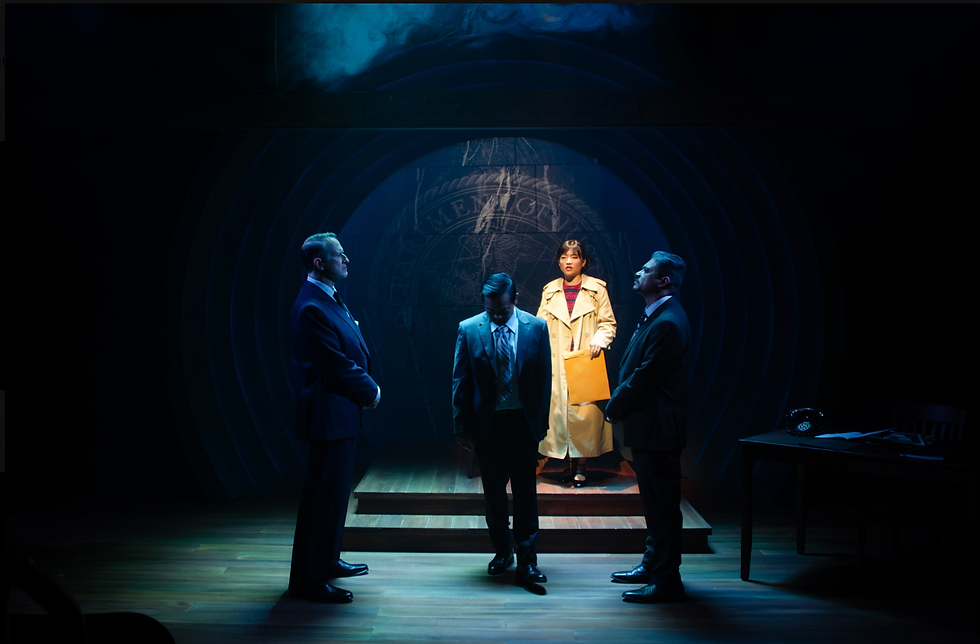
The design elements of the show are nicely showcased, especially in moments when Xuesen is floating in space (after his death and during dream sequences). Yuki Izumihara’s projections of the moon and other celestial bodies, as well as of the more Earthly locales, help create a sense of place as the scenes shift so quickly. John Zalewski’s sound and Joey Guthman’s lighting amplify the shifts in location and help Wyenn delineate different playing spaces.
At the center of Randy Wong-Westbrooke’s set is a spherical orb inside concentric circles that resembles the cross-section of a rocket engine, but also echoes both the orbits of the planets in our solar system and the layers of Xuesen’s different identities and priorities.
Costume designer Mylette Nora has her hands full with the sheer number of characters played by Edge and Pallo, and her wardrobe choices help distinguish the different roles when the character shifts come as rapidly as they do.

Having been a friend and colleague of Henry Ong during his lifetime, I was touched to see his work continue to be performed even after he’s left this Earth. As such, the first lines of the play, spoken by Xuesen after his own death, feel like they might have been spoken by Henry himself:
"Hello. What are you doing down there? You should be up here with me. Believe me, it’s a much better view. You’ll have a much clearer perspective.”
Except Henry might add, “And who are these famous people?”
With his play, he helped answer that question about at least one of them: a pioneer of the space age whose story deserves to be more widely known.
“Ascent” continues through June 14 at Skylight Theatre, 1816 ½ N. Vermont Ave., Los Angeles, with shows Thursdays, Fridays and Saturdays at 8 p.m., and Sundays at 3 p.m. For tickets and other information, visit Skylighttheatre.org or call the box office at 213-761-7061. Run time is 1 hour and 45 minutes with no intermission.


Comments