Review: History brought to disco life in ‘Here Lies Love’ at Mark Taper Forum


There are a surprising number of parallels between Imelda Marcos and Alexander Hamilton: both grew up on small islands; both sailed to more cosmopolitan cities in search of better lives; both engaged in politics, appreciated sartorial finery, and were involved in violent episodes with political rivals; both strongly influenced the histories of their respective nations; and of course, both had sung-through musicals about them in the 2010s that began as concept albums and premiered at New York’s The Public Theater.
In fact, what David Byrne (music and lyrics) said about his idea for the concept album that became “Here Lies Love” could just as easily apply to “Hamilton”: “The story I am interested in is about asking what drives a powerful person—what makes them tick? How do they make and then remake themselves?”
Where the similarities end is run time: while “Hamilton” clocks in at nearly 3 hours, “Here Lies Love” tells its tale in a neat 95 minutes. More seriously, though, this musical about the rise of Imelda Marcos — directed by Snehal Desai, Center Theatre Group’s artistic director — brings to light a history unknown to most Westerners.
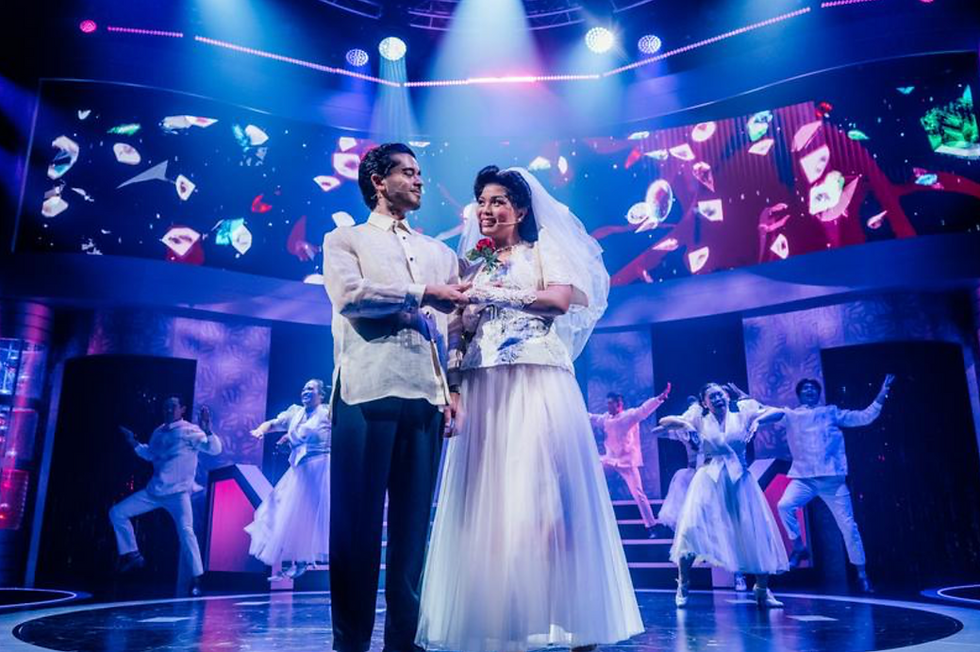
Growing up poor in Tacloban, a city on the island of Leyte in the Philippines, 16-year-old Imelda Romualdez (Reanne Acasio) dreams of being in magazines as she sings the title song “Here Lies Love” with childhood friend Estrella (Carol Angeli). (Though the real Imelda did not grow up in poverty, she would later make that claim for political expediency.)
Imelda’s teenage crush, Ninoy Aquino (Joshua Dela Cruz), is introduced in “Child of the Philippines,” a catchy tune that combines elements of doo-wop and hip-hop. While the two have a brief romance, he is far more interested in politics than she, so they go their separate ways (“Opposite Attraction”). Ironically, Imelda ends up falling for Ferdinand Marcos (Chris Renfro), a young senator whom she soon marries, and ends up getting into politics anyway, as first lady to Marcos.
The show traces Imelda’s rise to power, her battles with the populist firebrand that Aquino becomes, and how she and Ferdinand brutally rule the Philippines under martial law. The culmination of the historical narrative is the 1986 People Power Revolution, a series of nonviolent uprisings that led to Ferdinand and Imelda fleeing to Hawaii with their ill-gotten wealth, courtesy of the U.S. government.

A lot of history is packed into the show’s compact runtime, delineated by Yee Eun Nam’s dynamic projections, and a framing device of a hostess named Imeldific (Aura Mayari, of “RuPaul’s Drag Race” fame), whose name is from an expression coined by the real Imelda referring to excessive opulence or over-the-top luxury (e.g., her famous shoe collection).
Echoing The Engineer in “Miss Saigon” or The Emcee in “Cabaret,” Imeldific alternates between presentational narration and biting commentary, frequently reminding us of the colonial shadow cast over the Philippines (as in the opening number “American Troglodyte”).
That tension between Filipino identity and Western-imposed culture infuses the piece throughout. Traditional Filipino dances like tinikling (or tiniclín) are incorporated into “When She Passed By” (a credit to Desai’s direction), and Jaymee Ngernwichit’s costume design prominently feature Philippine flag colors, barong tagalogs and other “tropical white” attire.
At the same time, the Western-influenced aspirations of the diva at the center of the story, such as disco, are omnipresent in Arnel Sancianco’s scenic design, Ngernwichit’s costuming (love the disco-ball helmets in “Dancing Together” and Imeldific’s dress!), William Carlos Angulo’s invigorating choreography, and Marcella Barbeau’s kinetic, multi-hued lighting, festooned with pops of neon.

Desai’s direction is creative and dynamic, using all parts of the stage and even some spaces within the house. He involves audience members in the action on stage (though, by some accounts, less so than in other productions of the show) and showcases clever prop usage in staging Imelda’s journey from Leyte to Manila.
The all-Filipino cast is solid across the board, including an ensemble that energetically dances the night away. Dela Cruz is charismatic as the people’s champion, and his farewell ballad, “Gate 37” is powerfully tragic. Renfro is seductive as the young Marcos (and skillfully executes magic tricks in “A Perfect Hand”), becoming menacing as he grows older and more dictatorial. And Acasio showcases tremendous range in portraying a young rural girl who becomes an icon. The power of her voice shines on “Eleven Days,” and she has her “Evita” moment (albeit disco-infused) in “Why Don’t You Love Me?”

When Marcos takes ill and Imelda truly ascends to power, the staging of her anger at his infidelity (“Poor Me”) brings to mind Eliza’s “Burn” in “Hamilton.” At the same time, while “Here Lies Love” bears many surface-level similarities to Lin-Manuel Miranda’s magnum opus, it lacks the emotional stakes, humor and depth of feeling that catapulted the latter to box office and Tony-winning glory. Byrne and Fatboy Slim’s songs are danceable and skillfully combine genres, but they lack heart and panache, and none of them stick in your head after the performance.
The show’s most memorable and powerful moment, however, comes in its final number dramatizing the 1986 People’s Protest. The projections in that scene, with the words of actual citizens comprising its song lyrics, are beautiful as ordinary Filipinos rise up nonviolently against a brutally dictatorial regime. Even Imeldific’s garb is muted and less fabulous than usual.
But the cherry on top is a cameo by Filipina musical-theatre stalwart Joan Almedilla, who plays Aurora Aquino, Ninoy’s grieving mother. The song brings home a message that’s ripe for our times: “You might think you are lost, but then you will find, that God draws straight, but with crooked lines.”
“Here Lies Love” is extended through April 5 at Center Theatre Group’s Mark Taper Forum (at the Music Center), 135 N. Grand Ave., Los Angeles, with shows Tuesdays through Thursdays at 7:30 p.m., Fridays at 8 p.m., Saturdays at 2 p.m. and 8 p.m., and Sundays at 1 p.m. and 7 p.m. For tickets and other information, visit CenterTheatreGroup.org or call the box office at 213-628-2772. Run time 95 minutes with no intermission.


Comments